Recently, Viet Duc University Hospital successfully performed the first domino organ transplant surgery in Vietnam. This is a complex medical technique that maximizes the use of donated organs to save multiple patients, marking a breakthrough in the field of multi-organ transplantation in the country’s medicine.
Progression of the domino organ transplant chain
The surgical process was initiated from the donated organs of a brain-dead patient due to a traffic accident. The donated organs included a heart, a liver, and two kidneys. In this transplant chain, the heart and liver were simultaneously transplanted into a male patient suffering from a rare metabolic disorder called amyloidosis. Unlike conventional surgeries, the explanted liver from the amyloidosis patient was not discarded but was subsequently used as a graft for a third patient suffering from liver cancer on a background of cirrhosis. Concurrently, the two kidneys from the original donor were also successfully transplanted into two other cases of kidney failure.
Scientific basis and superiority of the domino transplant technique
Amyloidosis is essentially a metabolic disorder originating from a genetic mutation, causing the liver to produce abnormal proteins. These proteins deposit in various organs, causing peripheral nerve damage and severe heart failure. Replacing only the heart would not completely resolve the root cause, as the liver would continue to produce pathological proteins, leading to the risk of recurrent damage to the newly transplanted heart. Therefore, the indication for simultaneous heart and liver transplantation is the most optimal treatment solution.
Regarding the principle of organ reuse, the liver of the amyloidosis patient only has a single defect in the function of producing abnormal proteins, while all other metabolic functions of the liver operate normally. Medical literature records that the accumulation process of this protein to cause clinical pathological manifestations usually takes two to three decades. Because of this delayed pathogenesis mechanism, the defective liver remains a precious chance of life for elderly patients or those facing a high risk of death from liver cancer. The application of the domino transplant in this case fully meets the strict standards of medical indications as well as medical ethics.
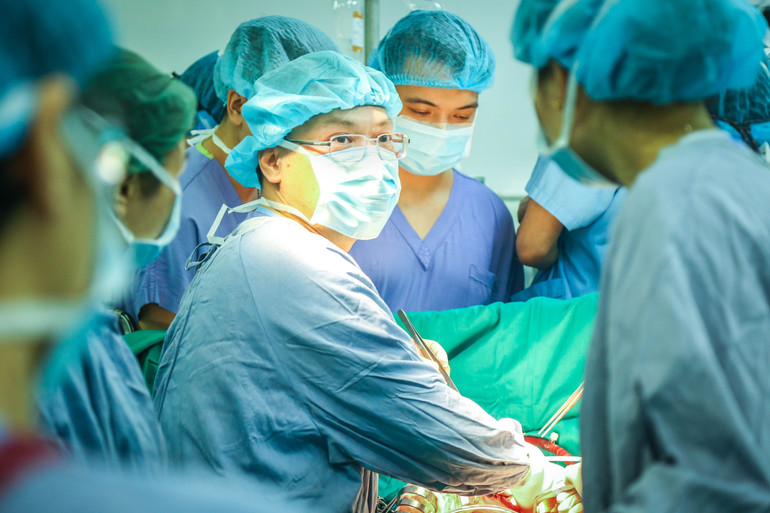
Doctors perform liver and heart transplants for the recipients.
Professional challenges and the recovery process
The domino transplant technique poses a series of major surgical challenges. The process of dissecting the liver from a person with amyloidosis requires extremely sophisticated techniques, as the surgeon must ensure the explanted organ retains intact vascular and biliary structures to continue transplanting it into the next recipient. Performing two major surgeries of heart and liver transplantation simultaneously on the same patient further increases the level of complexity, requiring rhythmic coordination and absolute precision from multidisciplinary teams.
Statistics show that the number of simultaneous heart and liver transplants for amyloidosis worldwide is currently very modest, mainly concentrated in large medical centers in the Americas and Europe, and has rarely been recorded in Asia. However, the surgical time in Vietnam was significantly shortened compared to the world average. The optimization of surgical time created favorable conditions for the recovery of the transplanted organs. Patients were extubated just twelve hours after surgery. After three days, the patients were awake, able to sit up, eat normally, and their vital functions gradually stabilized.
Practical significance and development orientation
The success of the surgery is not only a milestone in terms of professional technique but also carries profound humanitarian significance, reflecting the perspective of optimally using the very scarce source of donated organs. By reusing grafts scientifically, the health sector can prolong multiple lives from a single donor source.
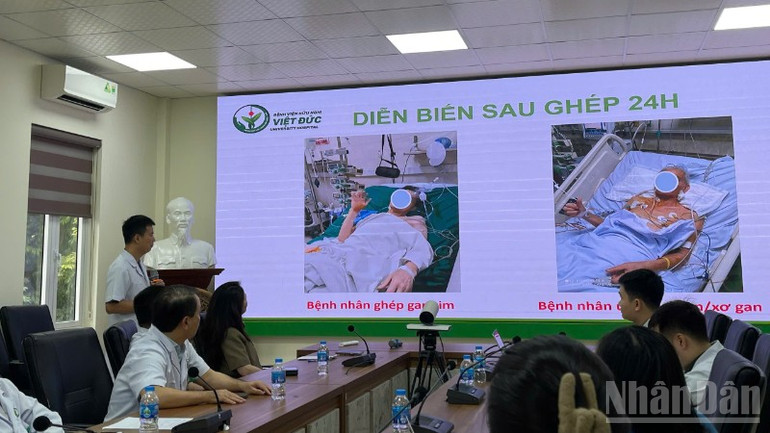
Associate Professor. Dr. Nguyen Quang Nghia, Director of the Organ Transplant Center, Viet Duc University Hospital, provides information on the patients’ health status after the transplant.
This event affirms that the capacity of Vietnam’s healthcare has approached international standards, opening up great prospects in developing high-quality healthcare combined with medical tourism. In the future, complex organ transplant techniques will continue to be expanded and transferred to the network of public and private medical facilities nationwide. At the same time, the health sector is also preparing resources to advance toward performing new specialized organ transplant techniques such as uterus, pancreas-kidney, and intestinal transplant to meet the increasing demand for treatment.