On December 6, 2025, the Center for Support & Continuing Education (under the Vietnam Medical Association) successfully organized an online scientific seminar on comprehensive solutions in the management of musculoskeletal diseases. The program attracted the participation of leading experts, updating the latest knowledge on the diagnosis and treatment of low back pain and spondyloarthritis, emphasizing the role of selecting safe and effective non-steroidal anti-inflammatory drugs (NSAIDs).
The online scientific seminar “Comprehensive Solutions with NSAIDs in Musculoskeletal Disease Management” took place under the chairmanship of Assoc. Prof. Dr. Nguyen Vinh Ngoc – Vice President of the Hanoi Rheumatology Association, along with two reporters: Dr. Tran Nam Chung – Head of Musculoskeletal Department, University of Medicine and Pharmacy Hospital – Vietnam National University, Hanoi, and Dr. Nguyen Thi Bich Ngoc – Head of Musculoskeletal Department, E Hospital. The event attracted nearly 21,000 views across platforms.
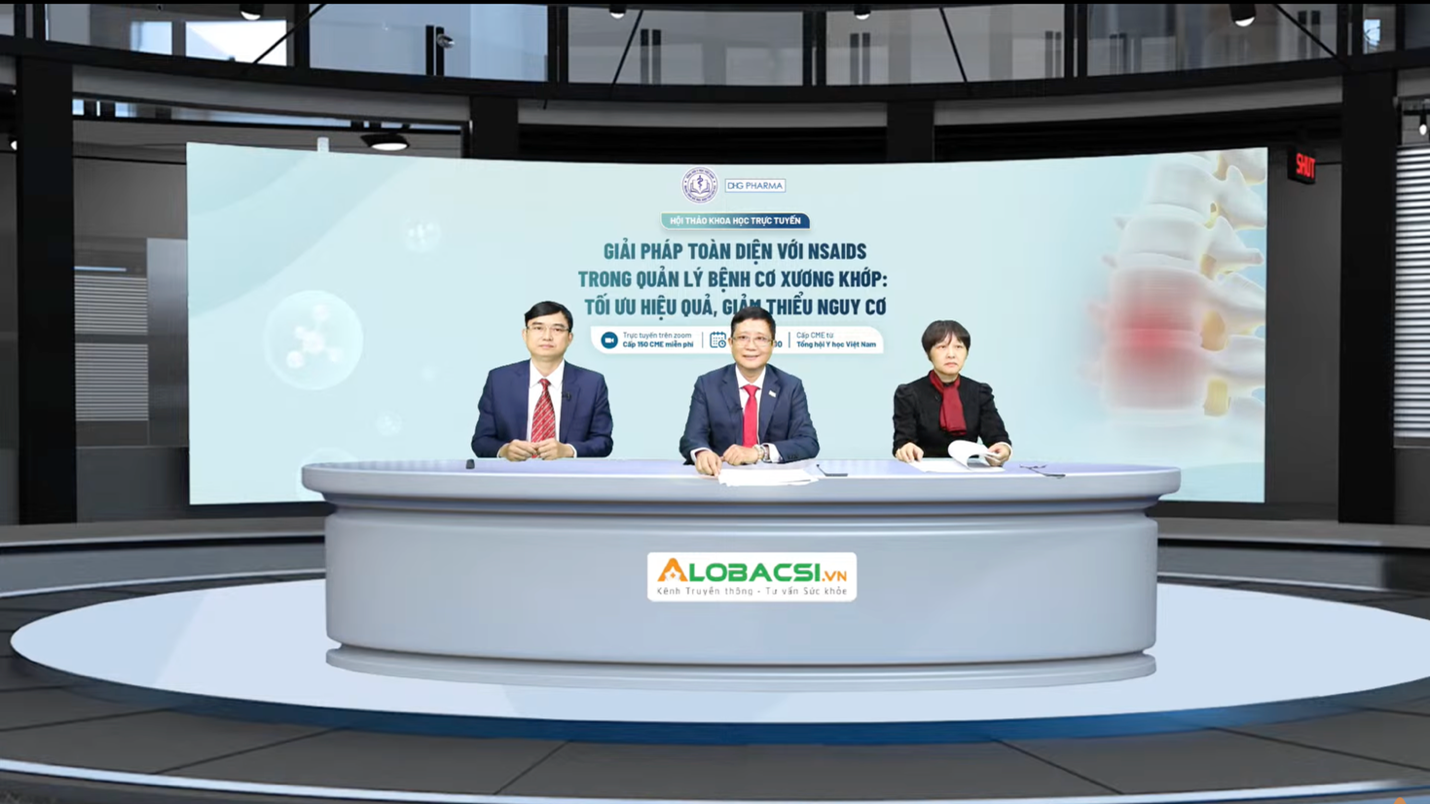
The chairperson and two speakers at the online seminar
Overview and Screening Principles for Low Back Pain
According to Dr. Tran Nam Chung (Head of Musculoskeletal Department, University of Medicine and Pharmacy Hospital – VNU), low back pain is the most common issue in the group of musculoskeletal pathologies, significantly affecting labor productivity. The World Health Organization (WHO) estimated that over 600 million people suffered from this condition in 2020, and the figure is forecast to rise to 800 million by 2050.
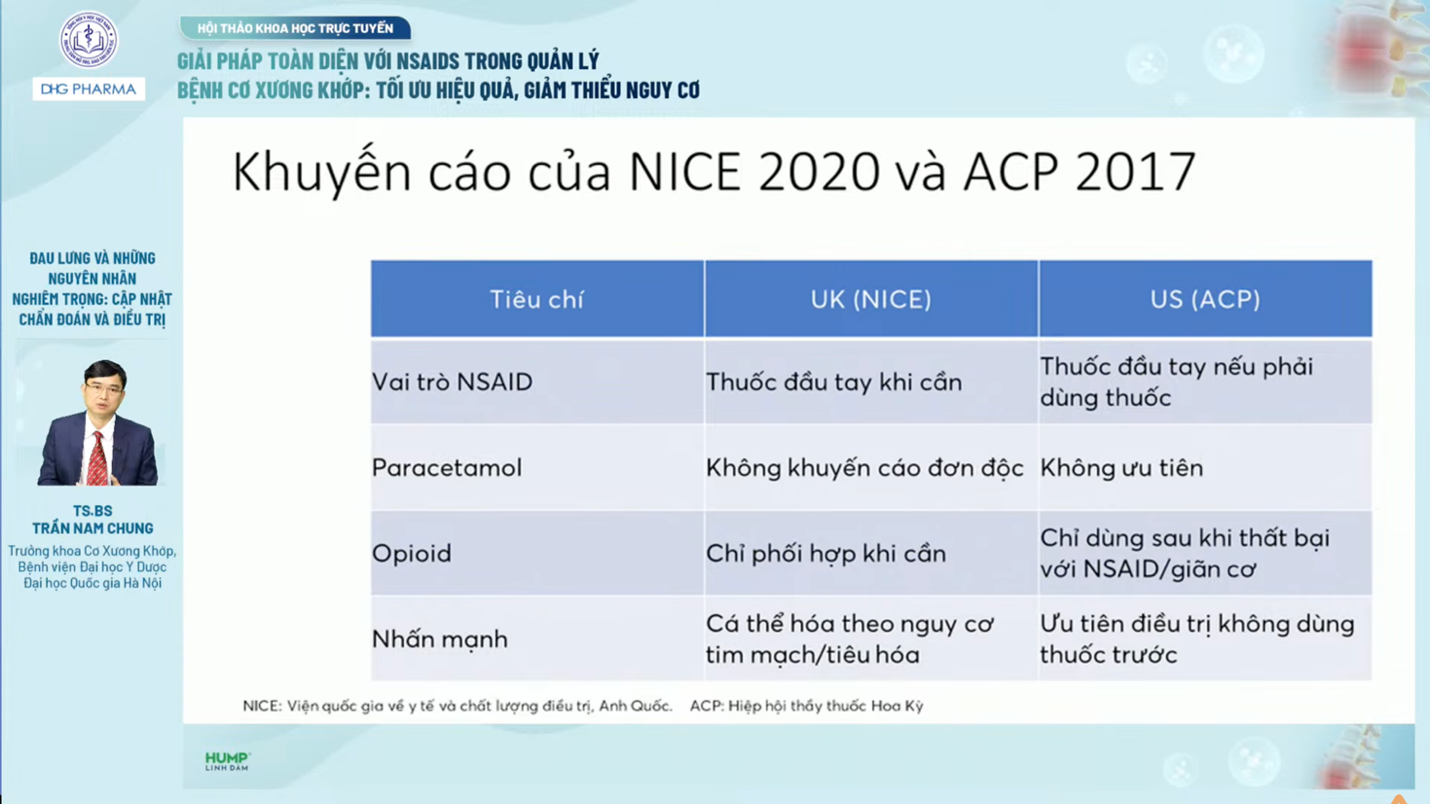
Dr. Tran Nam Chung – Head of Musculoskeletal Department, University of Medicine and Pharmacy Hospital – VNU shares an overview of the causes of low back pain and updates on diagnosis and treatment
Low back pain is classified based on duration (acute, sub-acute, chronic) and etiology (mechanical, non-mechanical, visceral). Although 80-85% of cases are non-specific low back pain (usually due to muscle strain), the systematic screening process always requires physicians to rule out dangerous causes first. Warning signs include: spinal infection, bone metastasis cancer, fractures, and cauda equina syndrome. Clearly distinguishing between mechanical pain and inflammatory pain is a key step in orienting the diagnosis of systemic inflammatory diseases.
Treatment Strategy for Low Back Pain and the Role of NSAIDs
In the treatment of low back pain, experts emphasize a multimodal approach, prioritizing non-pharmacological measures such as posture education, physical therapy, and maintaining physical activity. When medication is indicated, NSAIDs are considered the first-line choice.
However, prescribing must adhere to the principle of individualization based on the cardiovascular, gastrointestinal, and renal risks of each patient. The selective COX-2 inhibitor NSAIDs group (such as Celecoxib, Etoricoxib) is prioritized for use due to a better safety profile on the gastrointestinal tract compared to traditional NSAIDs groups, helping to optimize treatment efficacy and minimize risks.
Updates on Spondyloarthritis Management
Dr. Nguyen Thi Bich Ngoc (Head of Musculoskeletal Department, E Hospital) shared about spondyloarthritis – a complex pathology closely related to the genetic factor HLA-B27 and requiring a long-term treatment strategy. Modern diagnosis is based on the ASAS 2009 criteria and the role of MRI in detecting early inflammatory lesions (bone marrow edema), helping to intervene promptly before irreversible structural damage occurs.
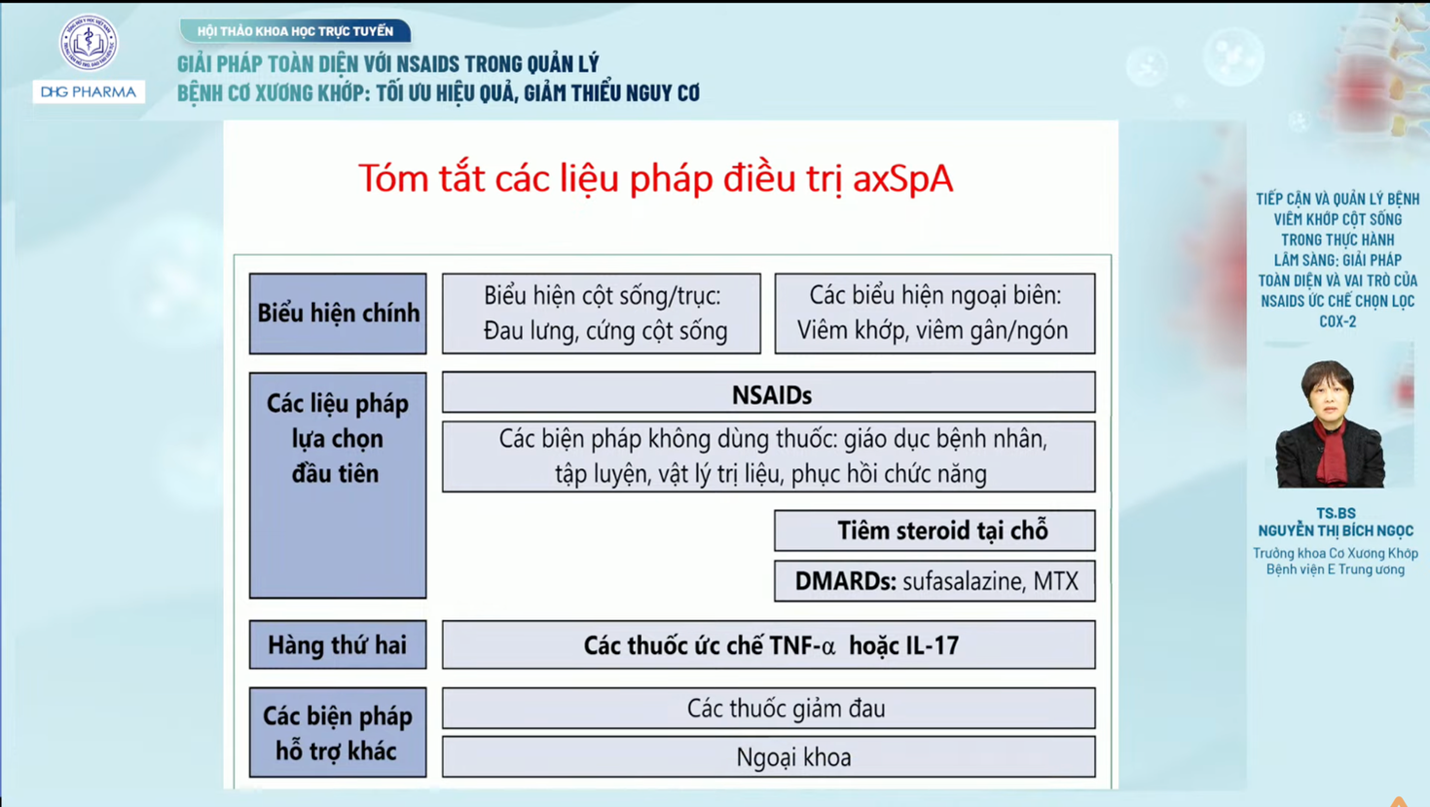
Dr. Nguyen Thi Bich Ngoc updates on the role of NSAIDs and selective COX-2 inhibitors in the treatment of spondyloarthritis pathology
In the treatment regimen for spondyloarthritis, NSAIDs play a pivotal role and are the first-line indication. Patients need to be trialed with at least two types of NSAIDs for a period of 2 – 4 weeks to assess response. Clinical reports show:
Atocib (Etoricoxib): Has the advantage of rapid pain relief, 24-hour duration of action, and superior efficacy compared to many other NSAIDs.
Celosti (Celecoxib): Proven to significantly reduce disease activity, improve motor function with low risk of gastrointestinal complications, and cardiovascular safety equivalent to Naproxen.
Other therapies, such as DMARDs (Sulfasalazine) are only effective for peripheral arthritis, while systemic corticosteroids are not prioritized for the axial form. When NSAIDs do not respond, new biological therapies are considered for the indication.
Conclusion
The seminar provided a comprehensive and practical perspective for medical staff. Understanding the correct causes, thorough screening, and selecting appropriate selective COX-2 inhibitor NSAIDs (such as Atocib and Celosti) are the keys to improving the quality of treatment and safety for musculoskeletal patients in Vietnam.
Center for Support & Continuous Education