In endodontic treatment, managing pain caused by acute pulpitis has always been a significant challenge for clinicians, especially when local anesthesia fails to achieve the desired effect. Currently, despite medical advancements, some dentists continue to use pulp devitalizing agents as a temporary solution for pain relief. However, modern medical evidence has highlighted serious risks associated with the use of these devitalizing agents.
1. Current status of pulp devitalizing agent use and clinical awareness
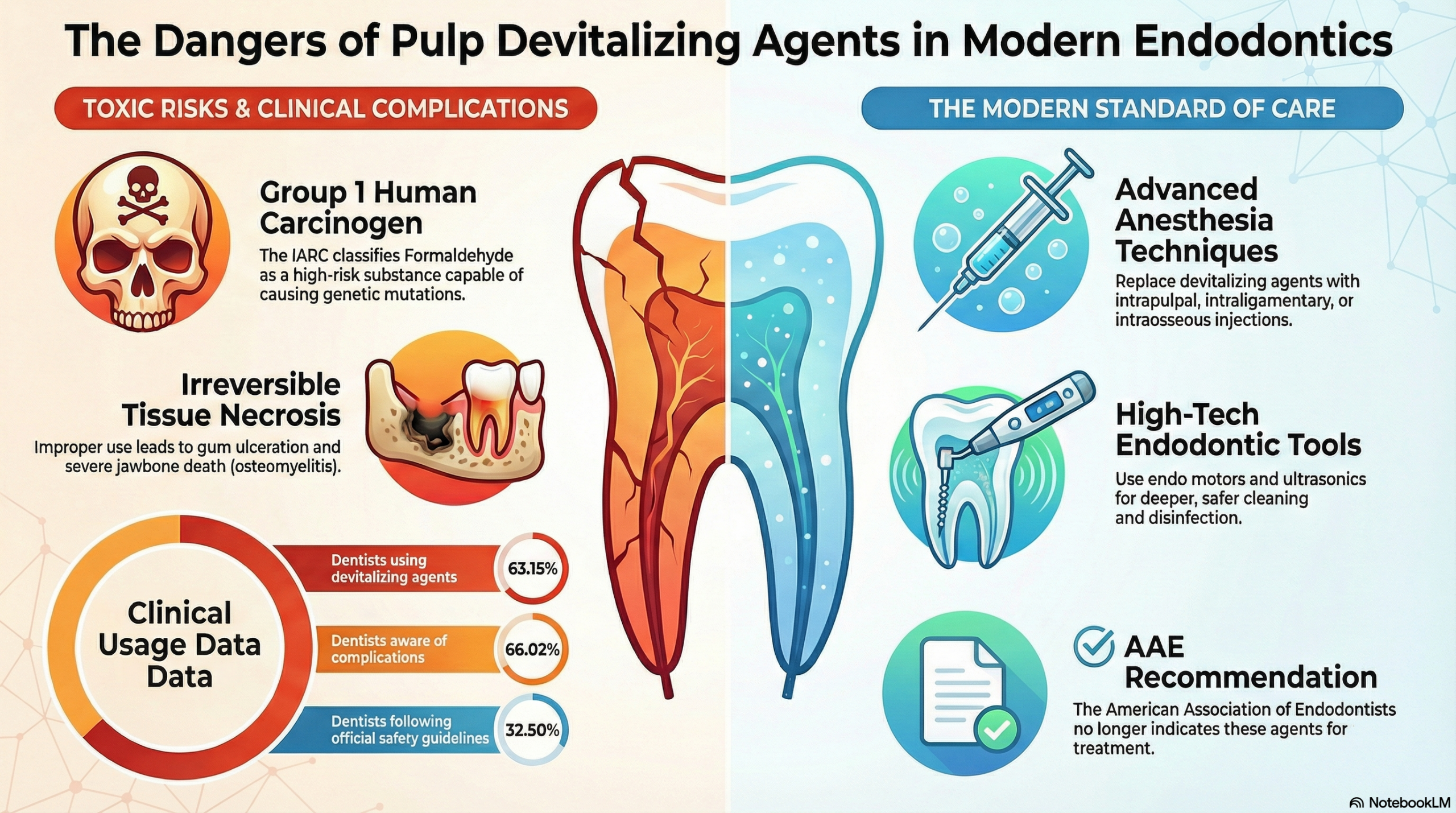
According to a 2021 multinational survey, up to 63.15% of dentists still use pulp devitalizing agents in their practice. Approximately 37.30% use them to manage pain when local anesthesia fails. It is concerning that while 66.02% of dentists are aware of potential complications, only 32.5% are well-versed in the restrictive recommendations from medical organizations.
2. Formaldehyde components and carcinogenic risks
Most current devitalizing agents, such as Depulpin or compounds containing Paraformaldehyde, are based on Formaldehyde. Since 2004, the International Agency for Research on Cancer (IARC) has classified Formaldehyde as a Group 1 carcinogen for humans. This active ingredient possesses high mutagenic and cytotoxic potential. When placed in the pulp chamber, these chemicals can spread into the systemic circulation, threatening the patient’s overall health.
3. Clinical complications and hard tissue damage
The use of these agents can lead to irreversible complications such as soft tissue necrosis, gingival sloughing, and mucosal ulceration. More severely, patients may suffer from osteomyelitis of the jaw and alveolar bone necrosis. Numerous reports have documented complex cases of mandibular osteomyelitis requiring invasive surgical interventions, such as debridement of necrotic bone or sequestrectomy, and even the extraction of healthy adjacent teeth. For these reasons, the American Association of Endodontists (AAE) has declared that the use of pulp devitalizing agents is no longer indicated.
4. Alternatives in modern endodontics
The current standard of care prioritizes advanced anesthesia techniques and supportive technologies to completely replace devitalizing agents. Clinicians can apply intrapulpal, periodontal ligament, or intraosseous anesthesia. Furthermore, the application of endodontic motors, ultrasonics, Diode Lasers, and operating microscopes helps optimize the cleaning process, enhance disinfection, and ensure clinical precision.
5. Conclusion
The use of Formaldehyde-containing pulp devitalizing agents is no longer compatible with modern medical standards due to systemic toxicity and the risk of severe necrosis. Clinicians should update their skills with advanced anesthesia techniques and new technologies to ensure patient safety.
MSc. DDS. Cao Thanh Hoa – Deputy Director of the Center for Support & Continuing Education